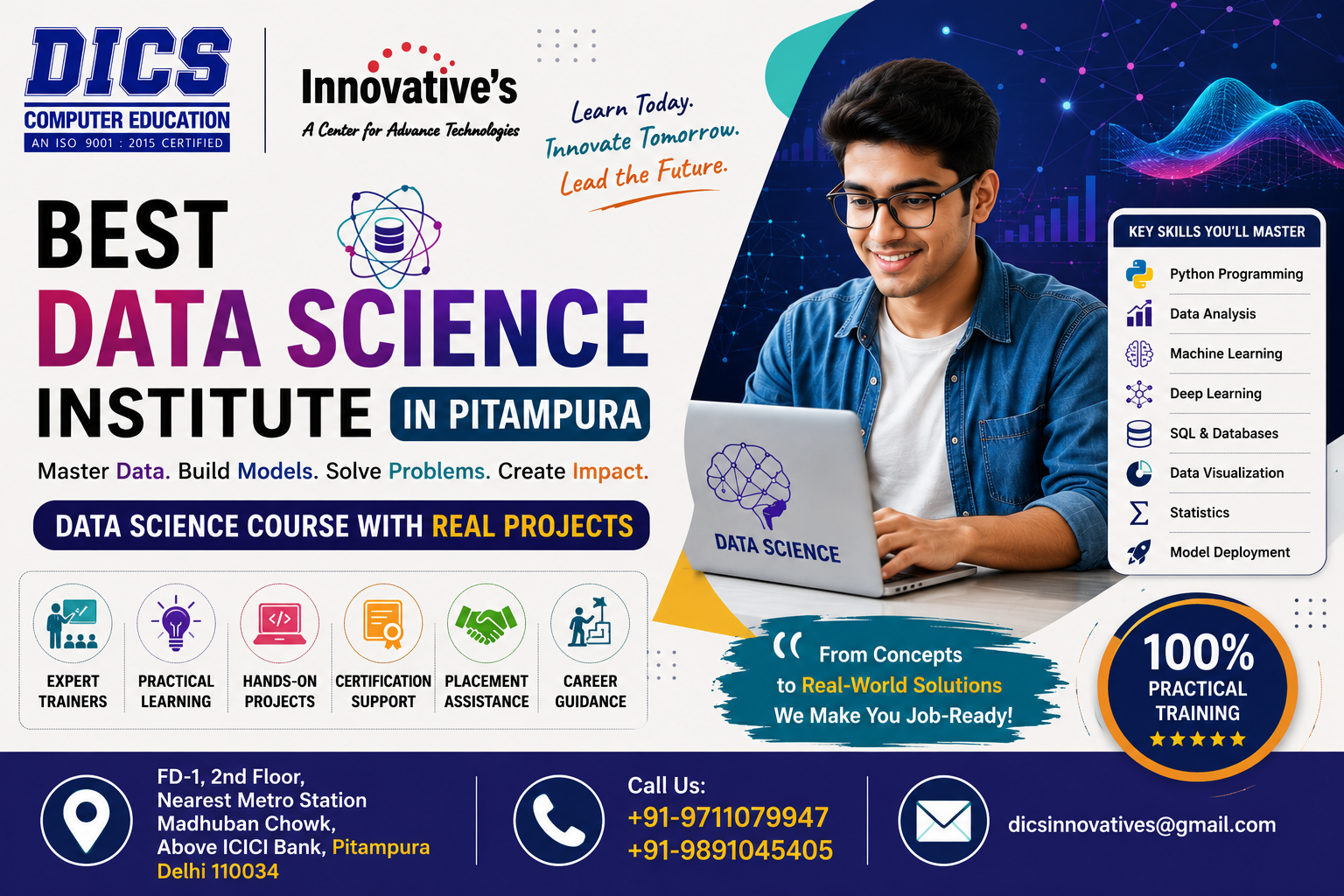
Businesses today are surrounded by information. Every online purchase, customer interaction, search, transaction, advertisement, and application generates data. But having data is not enough. Organisations need professionals who can study complex information, discover patterns, build useful models, and convert findings into practical business solutions. This growing dependence on data has made Data Science one of the most interesting technology-driven career fields. For students, graduates, freshers, and working professionals looking to enter this field, choosing the right training environment is an important first step. If you are searching for the Best Data Science Institute in Pitampura, DICS Innovatives offers practical and career-oriented learning focused on technical knowledge, projects, job skills, and placement assistance.
Data Science Begins with a Question
A business may want to predict which customers are likely to purchase a product, understand why customers are leaving, identify unusual transactions, forecast sales, or improve its marketing strategy. A Data Science professional uses data, analytical methods, programming, and statistical thinking to investigate such problems. This makes the field much broader than simply creating reports.
A good Data Science Course in Pitampura should therefore help learners understand the complete journey of data—from collecting and preparing information to analysing it, building models, interpreting results, and presenting insights. At DICS Innovatives, students can gradually develop this understanding through structured learning and practical exercises.
Build Your Foundation Before Moving to Advanced Concepts
For beginners, Data Science can appear challenging because it brings several subjects together. Programming, mathematics, statistics, databases, data visualisation, and Machine Learning may all become part of the learning journey. A structured approach can make these concepts easier to understand.
Students can begin with fundamental programming concepts and data handling before moving toward more advanced analytical techniques. Learning how variables, functions, conditions, loops, datasets, and basic statistical concepts work provides an important foundation for later topics.
The goal should not be to memorise programming commands. Instead, learners should understand how programming can be used to solve data-related problems. Once the basics become comfortable, students can explore data preparation, exploratory analysis, visualisation, predictive techniques, and Machine Learning concepts.
Learn How Data Becomes an Insight
A practical Data Science Course in Pitampura can help learners understand this process through hands-on exercises. Students can learn how to inspect datasets, clean information, identify patterns, perform exploratory analysis, and create visual representations of their findings.
Data visualisation is particularly useful because complex information can become easier to understand when presented through appropriate charts and graphs. However, creating a visual is only one part of the job. A professional also needs to know which information should be highlighted and what conclusion can reasonably be drawn from it.
Explore Python, Statistics and Machine Learning
Python has become an important technology in the modern data ecosystem because it provides a wide range of libraries and tools for data-related work. Learners can use Python to manipulate datasets, perform calculations, explore information, and develop analytical solutions.
Statistics also plays an important role in Data Science. Understanding averages, distributions, relationships, probability, and other statistical concepts can help professionals interpret data more carefully. These concepts become particularly useful when analysing patterns or evaluating the reliability of findings.
As learners progress, they can explore Machine Learning concepts that allow systems to learn patterns from historical data and make predictions or classifications. The objective is not simply to run a model but to understand the problem, prepare suitable data, select an appropriate approach, evaluate results, and communicate the outcome.
Projects Can Transform Learning into Experience
One of the strongest ways to understand Data Science is by working with real or realistic datasets. Practical projects require learners to apply multiple concepts together instead of studying each topic separately.
At DICS Innovatives, students can work on project-based assignments involving data preparation, analysis, visualisation, and analytical problem-solving. A project might focus on customer behaviour, sales forecasting, business performance, classification, or another practical use case.
Project work can also help students develop a professional portfolio. During an interview, a candidate who can explain the problem they solved, the dataset they used, the techniques they applied, and the insights they discovered has something practical to demonstrate.
Job Skills Beyond Programming
Becoming a successful Data Science professional requires more than knowing Python or Machine Learning. Businesses also need people who can understand requirements, think logically, investigate problems, interpret results, and communicate findings clearly.
Skills Learners Can Develop
- Python and Data Handling: Work with datasets and perform analytical tasks.
- Statistics: Understand patterns, relationships, probability, and data interpretation.
- Data Visualisation: Present information through meaningful charts and visual reports.
- Machine Learning: Understand fundamental predictive and classification techniques.
- Problem-Solving: Approach business questions using structured analytical thinking.
- Communication: Explain technical findings in a clear and understandable manner.
These abilities can help learners become better prepared for professional environments where technical knowledge and business understanding need to work together.
Where Can Data Science Take You?
Data Science is relevant across industries because organisations in different sectors use data to improve operations and make decisions. Finance companies can use analytics for risk-related problems, retailers can study customer behaviour, healthcare organisations can analyse information, and technology companies can develop data-driven products.
After completing suitable training, learners can explore career opportunities such as Data Science Trainee, Junior Data Scientist, Data Analyst, Business Analyst, Machine Learning Trainee, Data Science Associate, and related analytical roles. Career progression depends on individual knowledge, experience, qualifications, portfolio quality, and continuous learning.
Placement Assistance for Career Preparation
Learning technical skills is an important part of career development, but entering the job market requires additional preparation. Freshers may have the necessary knowledge but still find it difficult to create an effective resume, explain projects, answer technical questions, or communicate confidently during interviews.
DICS Innovatives provides placement assistance and career-oriented support to help students prepare for professional opportunities. This can include resume guidance, interview preparation, mock interviews, communication development, portfolio support, and career counselling.
Who Can Join a Data Science Course?
A Data Science course can be considered by college students, graduates, freshers, IT learners, working professionals, and individuals interested in building a career in data-driven technology. Beginners can start with foundational concepts and gradually progress toward programming, analytics, statistics, and Machine Learning.
Learners from different educational backgrounds can also explore the field, although mathematics, logical thinking, and programming can become increasingly important as the course progresses.
Frequently Asked Questions
1. Is Data Science suitable for beginners?
Yes. Beginners can start with fundamental programming and data concepts before gradually moving toward statistics, data analysis, Machine Learning, and advanced topics.
2. What can I learn in a Data Science Course?
The training can include Python, data handling, statistics, data visualisation, exploratory analysis, Machine Learning concepts, and practical project work.
3. Do I need programming knowledge before joining?
Advanced programming knowledge is not compulsory for beginners. Programming concepts relevant to Data Science can be introduced progressively during training.
4. Does DICS Innovatives provide placement assistance?
Yes. DICS Innovatives provides placement assistance along with resume guidance, interview preparation, mock interviews, portfolio support, and career counselling.
5. What jobs can I explore after Data Science training?
Depending on your skills and experience, you can explore opportunities such as Data Analyst, Data Science Trainee, Junior Data Scientist, Business Analyst, Machine Learning Trainee, and Data Science Associate.