Data is quietly shaping the way modern businesses operate. A company may have thousands of customer records, sales transactions, website visits, marketing campaigns, and financial reports, but raw information has little value until someone can understand it. This is where Data Analytics comes into the picture.
Data Analytics helps businesses identify patterns, measure performance, understand customer behaviour, discover problems, and make informed decisions. Because of this growing dependence on data, professionals who can work with information and turn it into meaningful insights are becoming increasingly important.
For students, graduates, and working professionals planning to enter the technology or business analytics field, choosing the right training can make a significant difference. If you are looking for the Best Data Analytics Institute in Pitampura, DICS Innovatives offers practical, career-focused learning designed around analytics tools, real-world projects, job skills, and placement assistance.
Data Analytics Is About Finding the Meaning Behind Data
Many beginners assume that Data Analytics is simply about making charts or calculating numbers. There is much more to it.
An analyst starts with a question or business problem. They collect or access relevant information, clean the dataset, investigate patterns, compare results, create visualisations, and communicate what the findings mean.
Consider an online business experiencing a fall in sales. Simply knowing that sales have decreased is not enough. An analyst may investigate whether the decline is related to a particular product, location, customer group, marketing campaign, or time period.
Choose a Data Analytics Course That Goes Beyond Theory
A strong Data Analytics Course in Pitampura should help learners understand how data is handled from beginning to end instead of teaching tools in isolation.
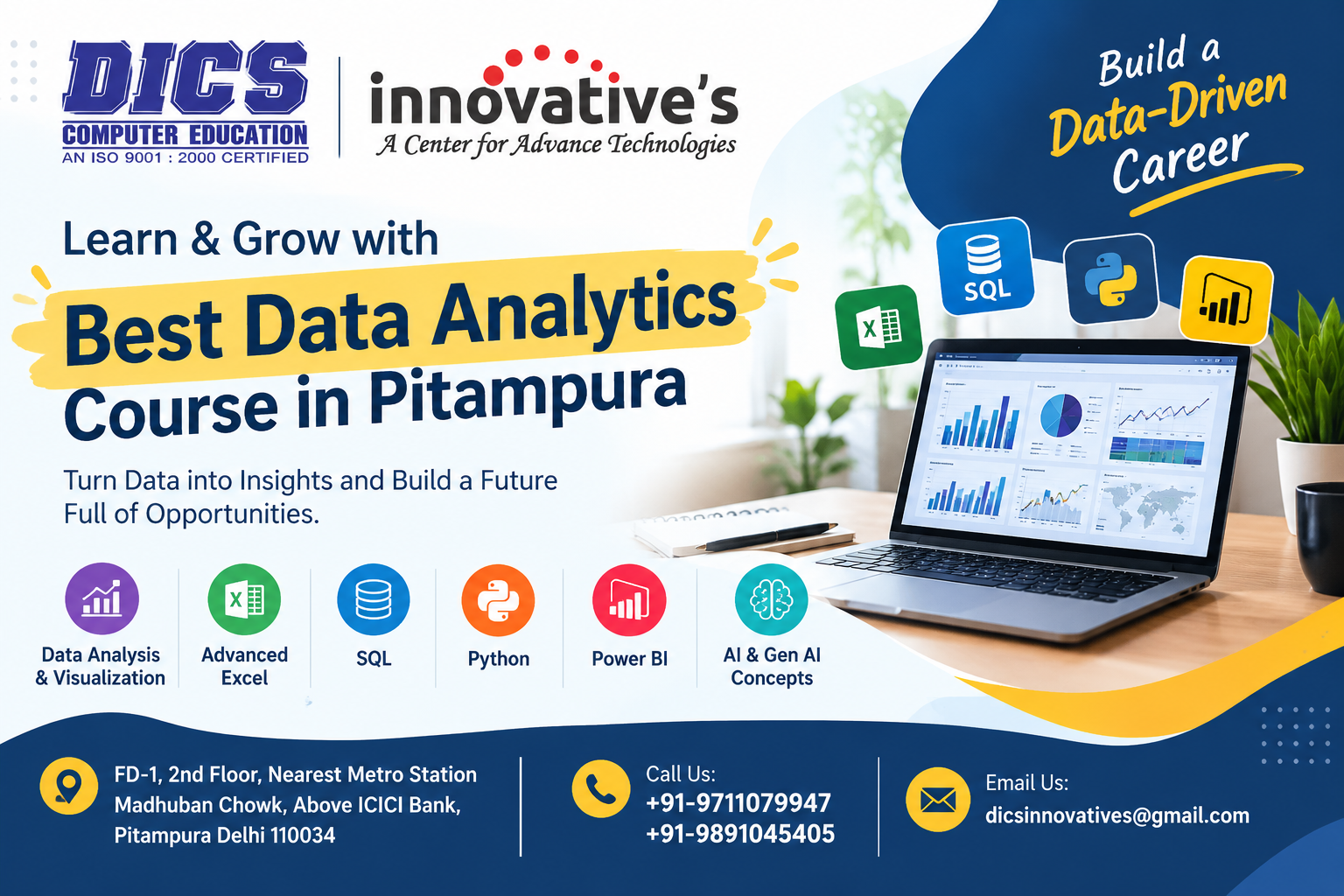
At DICS Innovatives, students can develop practical knowledge of important technologies such as Advanced Excel, SQL, Python, Power BI, data visualisation, reporting, and data analysis.
Excel provides a strong foundation for spreadsheet-based analysis and reporting. SQL helps learners work with information stored in databases. Python can be used for data processing and analysis, while Power BI can transform data into interactive reports and dashboards.
The important part is understanding how these technologies fit into an actual analytical workflow.
From Raw Records to Useful Insights
Real-world data is rarely as clean as a classroom example. It may contain duplicate entries, missing values, inconsistent formats, or irrelevant information. Before analysing such data, an analyst needs to prepare it properly. This is where practical training becomes valuable.
Students can learn how to inspect datasets, organise information, clean errors, perform calculations, identify trends, and present findings. Working on realistic examples can help learners understand that Data Analytics is a process rather than a single software skill. The more learners practise this process, the more naturally they begin to approach problems from an analytical perspective.
Projects Can Change the Way You Learn
There is a big difference between completing ten exercises and building one meaningful project. Exercises help students understand individual concepts, while projects require them to connect those concepts. A project may involve cleaning a dataset, analysing performance, creating a dashboard, identifying trends, and explaining the results.
For example, a student could work on a sales analytics project where different products, regions, months, and customer categories are compared. The objective would not simply be to create attractive charts. The student should be able to explain what the data indicates and what conclusions can reasonably be drawn.
Build Job Skills Along With Technical Knowledge
Employers generally look beyond software names mentioned on a resume. They want people who can understand problems, work accurately with information, and communicate their findings.
A job-ready Data Analytics learner should gradually develop skills such as:
- Advanced Excel, SQL, Python, and Power BI
- Data cleaning, analysis, and visualisation
- Dashboard and report creation
- Analytical thinking and problem-solving
- Communication and presentation of insights
These skills can support responsibilities in areas such as reporting, business operations, marketing, sales analysis, MIS, finance, and data analysis.
Communication deserves special attention. An analyst may understand the numbers perfectly, but if they cannot explain the result to a manager or client, the value of their analysis becomes limited.
Learn to Ask Better Questions
One of the most powerful skills an aspiring analyst can develop is curiosity. Instead of asking only, “What are the sales?” an analyst may ask, “Which products are performing best?” “Which locations are declining?” “What changed compared with the previous period?” or “Which customer segment contributes the most revenue?”
Better questions often lead to better analysis. This mindset can help students move away from simply producing reports and towards understanding what the information is actually communicating.
Data Analytics Can Open Different Career Directions
One reason Data Analytics attracts learners is its application across different industries. Businesses in retail, banking, healthcare, e-commerce, education, marketing, logistics, finance, and many other sectors work with data.
Depending on qualifications, practical knowledge, and experience, learners can explore roles such as Data Analyst, Junior Data Analyst, MIS Analyst, Reporting Analyst, Business Analyst, or other data-related positions.
Career development does not have to stop after learning the basic tools. Professionals can later strengthen their knowledge of statistics, Python, SQL, Power BI, machine learning, or other advanced technologies.
Placement Assistance for the Next Career Step
Learning technical skills is important, but students also need to prepare themselves for the recruitment process. DICS Innovatives provides placement assistance to eligible students to support their career preparation. This can include guidance related to resume building, interview preparation, communication, project presentation, and understanding workplace expectations.
A practical project can become especially useful during interviews because candidates can discuss the problem they worked on, the tools they used, the challenges they faced, and the insights they discovered. Placement assistance is designed to support the student’s preparation, while consistent practice and skill development remain essential for individual career growth.
Why DICS Innovatives?
When searching for the Best Data Analytics Institute in Pitampura, it is important to look beyond attractive advertisements and certificates. The quality of practical training, project exposure, tools covered, trainer guidance, career preparation, and placement assistance can have a major impact on the learning experience.
DICS Innovatives focuses on career-oriented computer education and practical skill development. The Data Analytics training is designed to help learners understand the complete journey from raw data to meaningful information.
For someone serious about developing analytics skills, the right learning environment can provide direction, practice, and confidence to take the next step. Don’t just learn how to analyse data. Learn how to think with data, communicate insights, and solve problems that matter.
Frequently Asked Questions
1. Is Data Analytics suitable for beginners?
Yes. Beginners can start with fundamental concepts and gradually learn tools such as Excel, SQL, Python, and Power BI through structured practice.
2. What does a Data Analytics Course in Pitampura cover?
A course can include Advanced Excel, SQL, Python, Power BI, data cleaning, data analysis, data visualisation, dashboards, reporting, and practical projects.
3. Do I need programming knowledge to start Data Analytics?
No. Previous programming experience is not essential for beginners. Python can be learned gradually as part of the analytics journey.
4. Which job skills are important for Data Analytics?
Technical knowledge of Excel, SQL, Python, and Power BI is useful along with analytical thinking, problem-solving, data visualisation, reporting, and communication skills.
5. Does DICS Innovatives provide placement assistance?
Yes. DICS Innovatives provides placement assistance and career preparation support to eligible students.
6. Are practical projects important in Data Analytics?
Yes. Projects help learners apply different tools together, practise problem-solving, create portfolio work, and develop confidence in explaining their analytical approach during interviews.
7. Who can join a Data Analytics course?
Students, graduates, working professionals, and beginners interested in developing data-related skills can consider Data Analytics training and gradually build their technical foundation.