Every modern business produces data. Sales records, customer details, website traffic, advertising results, financial reports, inventory information, and employee performance all generate valuable insights. But raw data alone cannot help a company grow. Businesses need professionals who can examine information, identify patterns, understand trends, and convert numbers into meaningful business decisions. This is why Data Analytics has become an important career skill for students, freshers, graduates, and working professionals. If you are searching for the Best Data Analytics Institute in Pitampura, DICS Innovatives provides practical and career-oriented training designed to help learners understand analytics tools, develop job skills, work on projects, and prepare for professional opportunities.
When Data Becomes a Career Opportunity
Data Analytics is not simply about working with Excel sheets or creating attractive charts. It is about finding answers to business questions through information. Suppose a company notices that its monthly revenue has decreased. Instead of guessing the reason, an analyst can study sales records, product performance, customer behaviour, locations, and previous trends to understand where the problem exists. The findings can then help the business make better decisions.
This way of thinking makes analytics different from ordinary data handling. “A good analyst does not just ask what happened; they ask why it happened and what should happen next.” A structured Data Analytics Course in Pitampura can help learners develop this mindset while gradually introducing them to the tools and techniques used for professional analysis.
A Learning Path Designed Around Practical Understanding
For someone starting from scratch, analytics can appear complicated because it combines technology, numbers, business concepts, and problem-solving. A properly structured course can make the journey easier by introducing concepts progressively. Students can begin with data fundamentals and gradually move toward data cleaning, analysis, visualisation, reporting, databases, dashboards, and programming-based analysis.
At DICS Innovatives, learners can understand how the different stages of analytics connect with one another. Instead of learning isolated topics, they can explore how raw information is prepared, analysed, visualised, and finally converted into a report or business insight. This approach helps make the learning process more meaningful because students understand the purpose behind each step.
Explore Tools That Support Modern Data Analysis
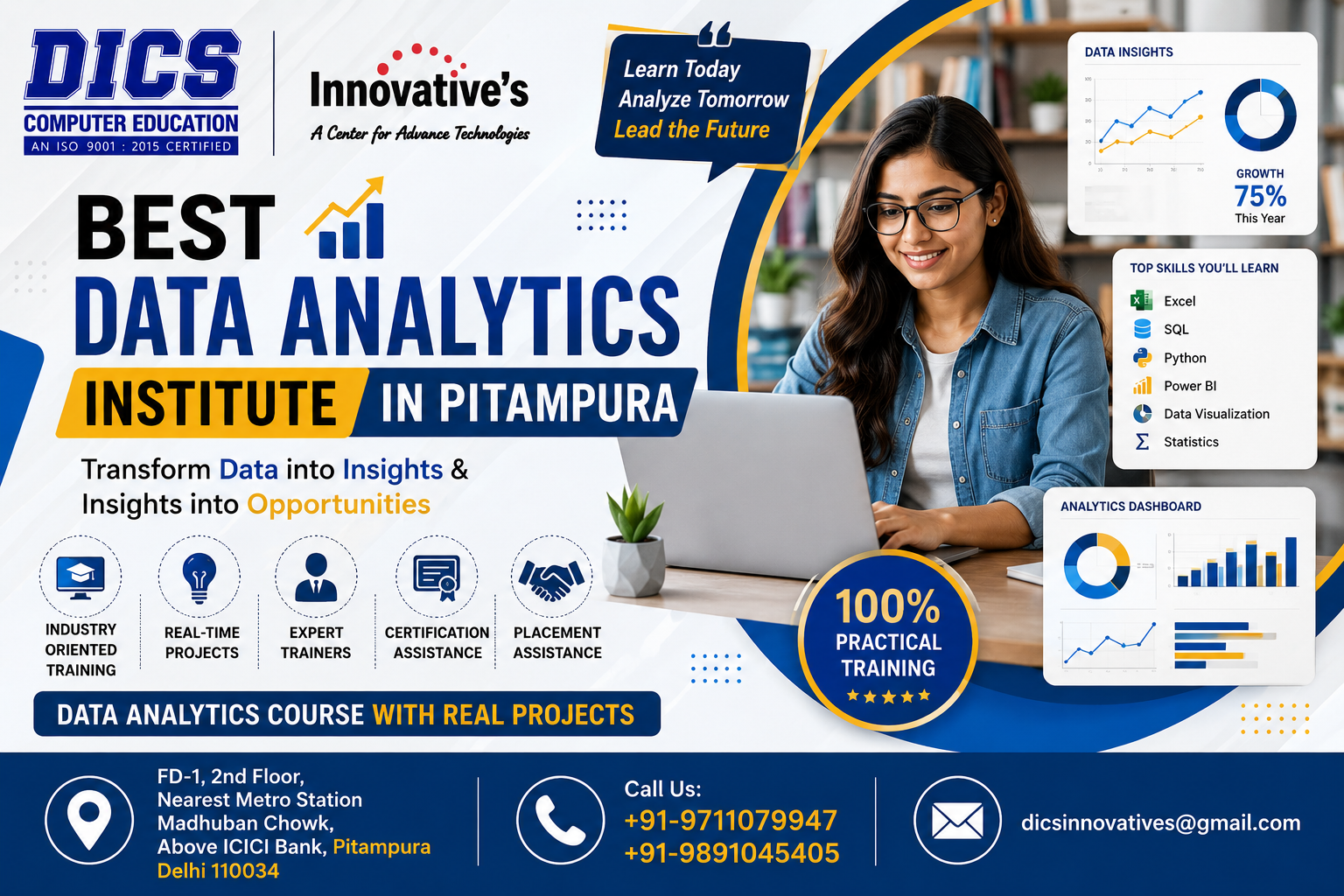
Today’s analysts may work with several technologies depending on the type of project and business requirement. Learning multiple tools can therefore help students understand different parts of the analytics workflow. A Data Analytics Course in Pitampura at DICS Innovatives can provide exposure to important areas such as Advanced Excel, SQL, Python, Power BI, data visualisation, and reporting.
Excel can be useful for calculations, data organisation, analysis, and reports. SQL helps professionals retrieve and manage information stored in databases. Python can support data analysis, automation, and more advanced analytical tasks, while Power BI allows users to create interactive dashboards and visual reports.
The objective should not be to simply remember the names of different tools. Students should learn how to select the appropriate tool according to the problem they are trying to solve.
Projects Turn Classroom Learning into Practical Skills
Imagine learning how to create a dashboard but never actually working with a complete dataset. The concept may be understood, but the practical challenges remain unfamiliar. Working on projects changes that experience. Students have to clean information, decide what is relevant, identify trends, select appropriate visualisations, and explain their conclusions.
At DICS Innovatives, practical assignments and project-based activities can help learners connect theoretical concepts with realistic business situations. Projects may involve sales analysis, customer behaviour, business reporting, performance comparisons, or dashboard creation. This experience can also help students develop a portfolio that demonstrates their capabilities.
A portfolio can be particularly useful for freshers because it gives them something practical to discuss during interviews. Rather than simply stating that they know Power BI or SQL, they can explain what they created, what problem they worked on, and what insights they discovered.
Job Skills That Can Make a Difference
A successful data professional needs more than technical knowledge. Employers also value candidates who can think logically, understand business requirements, identify important information, communicate findings, and pay attention to detail. This combination of technical and professional abilities can help learners become better prepared for workplace responsibilities.
Skills You Can Develop
- Data Handling: Organising, cleaning, and preparing datasets for analysis.
- Analytical Thinking: Identifying patterns, trends, relationships, and unusual results.
- Excel & SQL: Working with spreadsheets, databases, formulas, queries, and reports.
- Python: Understanding programming concepts useful for data analysis and automation.
- Power BI: Creating dashboards, visual reports, and interactive business insights.
- Communication: Presenting analytical findings clearly to different audiences.
- Problem-Solving: Using data to investigate questions and support business decisions.
Where Can Data Analytics Take You?
One of the advantages of analytics is its relevance across different industries. Banks use data to understand financial activity, retailers analyse customer purchases, e-commerce companies monitor online behaviour, marketing teams measure campaign performance, and logistics companies study operational efficiency. Healthcare, education, manufacturing, finance, technology, and many other sectors also depend on data.
After completing suitable training, learners can explore positions such as Data Analyst, MIS Executive, Reporting Analyst, Business Analyst, Operations Analyst, Business Intelligence Analyst, and Data Visualization professional. With experience and continuous learning, professionals can later explore advanced areas such as Business Intelligence, Data Science, Machine Learning, and AI-based analytics.
This makes analytics more than a single job role. It can become a foundation from which learners develop different career directions.
Placement Assistance for Your Next Professional Step
Learning analytics is one part of career preparation; knowing how to enter the job market is another. Freshers often need support with resumes, interviews, portfolio presentation, communication, and understanding how to explain their technical abilities.
DICS Innovatives provides placement assistance to help students prepare for professional opportunities. Career-oriented support can include resume guidance, interview preparation, mock interviews, communication improvement, portfolio guidance, and career counselling. Such preparation can help learners become more confident when communicating with recruiters and discussing their projects.
Why DICS Innovatives?
Selecting the Best Data Analytics Institute in Pitampura should involve more than looking at a course name or certificate. Practical exposure, relevant tools, project work, trainer support, career guidance, and placement assistance are important factors to consider when choosing a learning environment.
DICS Innovatives focuses on helping learners understand data analytics through structured and practical training. Students can work toward developing technical knowledge while improving their analytical thinking, project skills, and professional confidence.
If you are planning to enter the data-driven professional world, the Data Analytics Course in Pitampura at DICS Innovatives can provide a practical starting point for developing the knowledge and skills required in modern analytics roles.
Frequently Asked Questions
1. Is Data Analytics suitable for beginners?
Yes. Beginners can start with fundamental concepts and gradually progress toward Excel, SQL, Python, Power BI, visualisation, reporting, and project-based learning.
2. What will I learn in a Data Analytics Course?
The course can cover data handling, Advanced Excel, SQL, Python, Power BI, data visualisation, reporting, analytical thinking, and practical project work.
3. Do I need coding experience before joining?
No. Advanced programming knowledge is not compulsory for beginners. Programming concepts relevant to analytics can be introduced progressively during training.
4. Does DICS Innovatives provide placement assistance?
Yes. DICS Innovatives provides placement assistance along with career guidance, resume support, interview preparation, mock interviews, and portfolio guidance.
5. What career options are available after Data Analytics training?
Depending on your skills and experience, you can explore roles such as Data Analyst, MIS Executive, Reporting Analyst, Business Analyst, Operations Analyst, Business Intelligence Analyst, and Data Visualization professional.